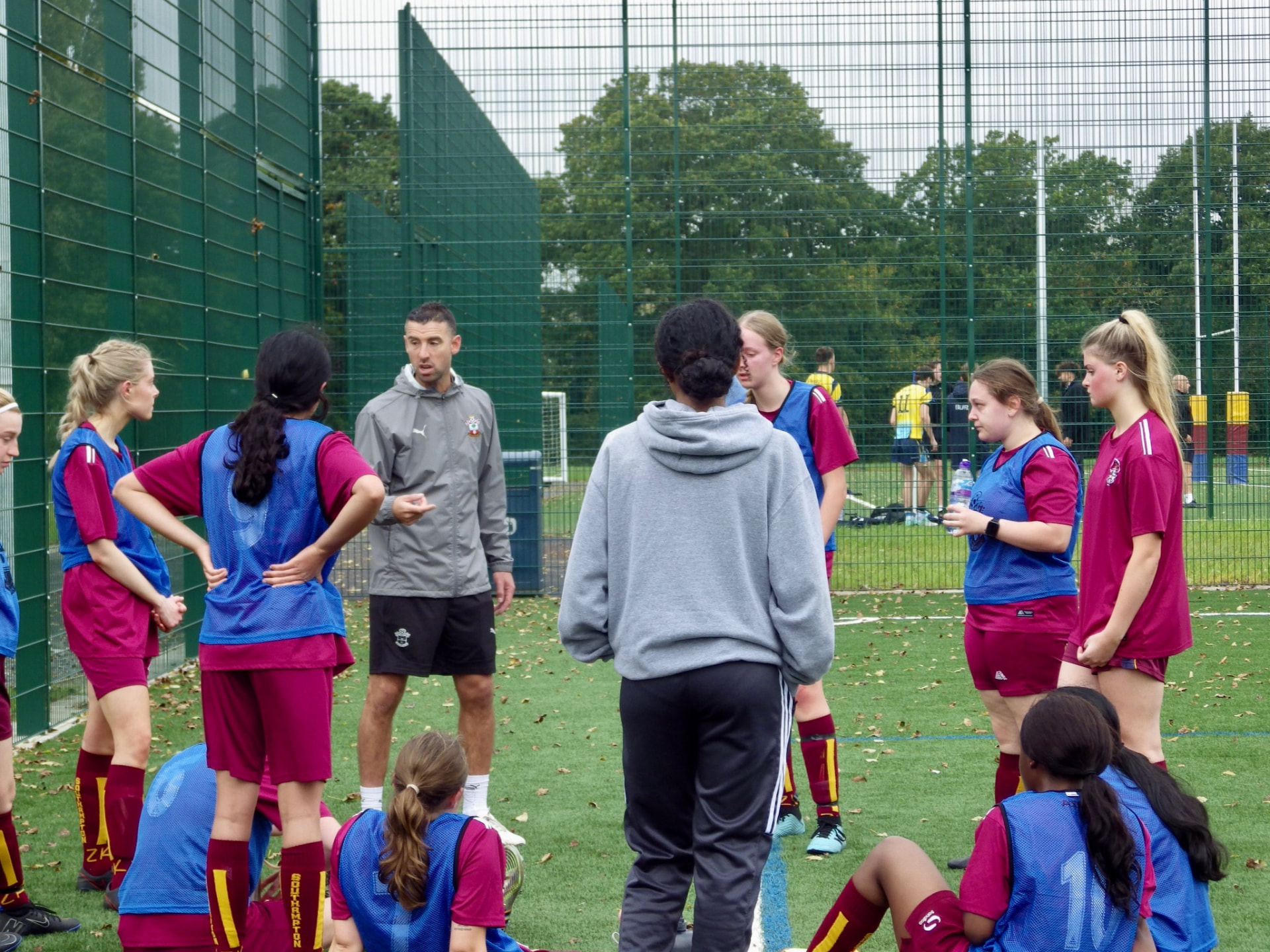
Can we be direct immediately after winning the ball back, either by passing forward or driving forward?
Numbers
The practice can use matched numbers or overloads, with a minimum of 3v3.
How it works
This is a directional practice with two teams. Each team attacks a score zone at one end of the pitch, which extends across the full width.
Each team has a player locked in their attacking score zone, who can move across its full width to create passing options.
Teams score 1 point by passing to their player in the score zone. After scoring, both teams immediately switch direction and attack the opposite end.
Transitions
Award 3 points if, immediately after winning possession:
The first pass reaches the player in the score zone.
The player winning the ball drives into the score zone.
The practice encourages players to recognise opportunities to play or drive forward immediately after regaining possession.
Progressions
Require a supporting runner: A direct pass or drive only earns 3 points if a teammate also reaches the score zone.
Reduce the available space: Narrow or shorten the playing area to increase pressure on the first action after regaining possession.
Regressions
Widen the pitch: Create more space to drive forward and make forward passing lanes easier to find.
Allow two passes for the bonus: Award 3 points if the team reaches the score zone within two passes of winning possession.
Videos
Video 1: OOP-IP: passing or driving forward immediately after winning the ball back
Out of Possession · Pressing
Pressing Practice
Aim
To understand when to press, who presses, and how to press the next pass, while staying connected as a unit.
Numbers
Teams can be matched or overloaded.
How it works
The in-possession team works around the outside of the square.
To unlock a shooting opportunity, they must complete either 6 passes or 2 passes through the square.
For added realism, once the 6th pass or 2nd pass through the square is completed, the in-possession team may only score in the goals in the opposite half.
The in-possession team may not enter the square unless they've lost the ball and are trying to win it back.
The pressing team are allowed to leave the square.
Pressing team's decisions
When to press and who presses the ball.
Everyone else must decide their role: press the next pass, screen passing lanes, cover, etc.
Transitions
If the pressing team wins the ball, they can attack any goal immediately.
The team that lost possession must then counter-press to win it back.
If they win it back, play continues.
Progressions
Give the in-possession team an extra player so the pressing team is overloaded.
Make the playing area larger.
Regressions
Match the numbers, or give the pressing team an extra player.
Make the playing area smaller.
Videos
Video 1: In-possession team complete 6 or more passes and scoresVideo 2: In-possession team completes 2 passes through the square and scoresVideo 3: Successful press and score
In Possession · Switching Play
Switching Play Practice
Aim
To create a shape that allows the ball to be moved quickly from one side of the playing area to the other.
Numbers
4v4, with a 2v2 in the middle. Can also be played with higher numbers.
If numbers are odd, use neutral players for the in-possession team.
How it works
2 players from each team are positioned on the outside, opposite each other on different sides of the pitch.
The aim is to get the ball from one side to the other.
The outside players can move along their line and act as bounce players for their team.
A point is scored each time the ball is successfully played from one side to the other.
Transitions
If the opposing team wins the ball, they must switch it from their player on one side to their player on the other.
Progressions
Overload one team.
Videos
Video 1: Switching play from one side of the playing area to the other