
Coaches Hub
Are Your Players Learning, or Just Getting Touches?
· @DaveRimmer
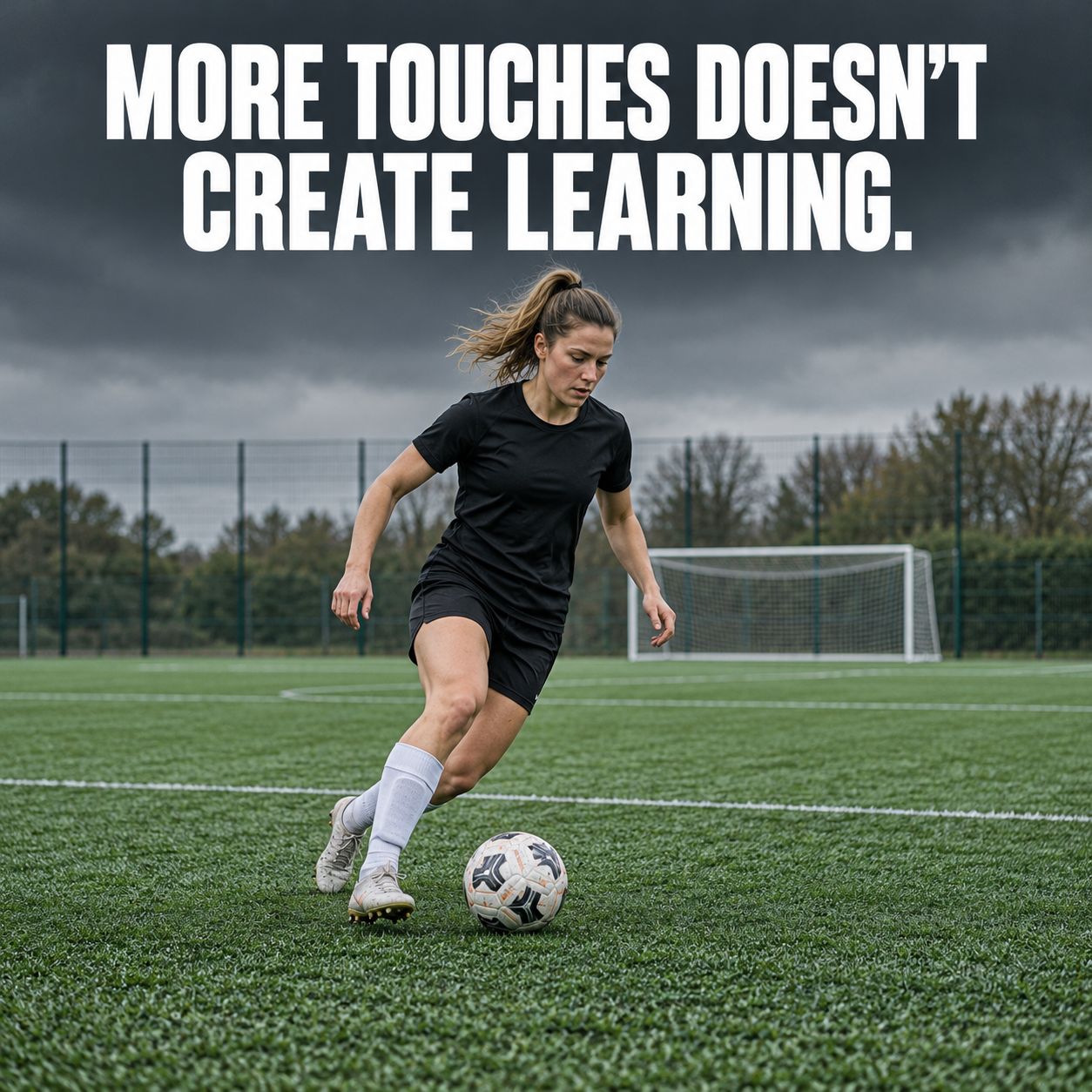
Ask any coach why small sided games work, and you'll hear the same answer: more touches.
It's a good answer. It came from a good place, too. For years, youth sessions were full of lines, queues and laps, with players spending more time waiting than playing. Counting touches helped change that.
But somewhere along the way, touches became the goal rather than a measure. And a session can be packed with touches while players learn very little that helps them in a game.
So the real question isn't how many touches your players get. It's what those touches are teaching them.
Not all touches are equal
Picture a passing square. Four players, two balls, no opponents. In ten minutes, each player might take 100 touches. On paper, that's a brilliant session.
Now picture a 3v3. Each player might only get 40 touches. But before every one of them, they had to look up, read the defender, find a teammate and choose what to do.
That's the difference. In a game, a touch never happens on its own. It comes after the player has seen the situation and decided what to do. A skill in football is three things together:
- See what's happening around you.
- Decide what to do about it.
- Do it, under pressure.
The passing square trains the third part. The 3v3 trains all three. So which group got more useful practice?
What players actually need from practice
In the 1980s, psychologist Gary Klein studied how experienced firefighters made decisions. He found they rarely weighed up options. They recognised the situation from experience and acted straight away.
Good footballers do the same. They build a library of situations in their heads, and every real decision in training adds a page. A touch in a passing square adds almost nothing, because the situation never changes.
The movement scientist Nikolai Bernstein had a phrase for good practice: repetition without repetition. Players should face the same kind of problem again and again, but never in exactly the same way. That's what games give you, and what most drills don't.
So players don't just need more touches. They need more problems to solve.
Five questions to check your session
Next time you plan a practice, ask yourself:
- Is there an opponent? Without one, there's nothing to read and no pressure to cope with.
- Do players have to choose? If there's only one right answer, they're following instructions, not making decisions.
- Does the situation change each time? If every rep looks the same, the library isn't growing.
- Is there a consequence? Lose the ball, and something should happen, like a counter attack or a point to the other team.
- Do players need to look up? If they can play with their eyes on the ball, they aren't learning.
If you answer no to most of these, your players are probably getting touches, but not much else.
How to make touches count
You don't need to throw your favourite practices away. Small changes can turn empty touches into useful ones.
- Add opposition. Even one passive defender gives players something to read.
- Add direction. Give the practice a target, like a goal, an end line or a gate, so every touch has a purpose.
- Go small sided. 2v2s and 3v3s keep every player involved and making decisions all the time.
- Add a condition. Reward a switch of play or a type of pass. New rules create new problems.
- Change the scoring. Players chase whatever earns points. Make a bonus for a skill you want to see, and watch it appear.
The aim is the same as before: plenty of touches. The difference is that each touch now comes with a decision attached.
Don't throw touches away
None of this means touches don't matter. Ball mastery is still important, especially for younger players. A player who is comfortable on the ball has more time to look up, because they don't need to watch their feet. Close control frees the eyes, and the eyes are where decisions start.
So ball mastery has a place, as a warm up, a focused block, or a regular part of sessions for younger age groups. Just don't let it be the whole session. The touch is the foundation. The decision is what turns it into football.
Count decisions, not just touches
Touches tell you how busy your players were. Decisions tell you how much they learned.
So the next time someone says a practice is great because of the number of touches, ask one simple question: touches doing what?
If the answer is seeing, deciding and doing, under pressure, against an opponent, in a situation that keeps changing, then you've got a session that will show up on match day.
Want practices that create more decisions? Try the free games in the Coach Game Lab, built to add problems, pressure and fun to any session.
0 views
Comments (0)
No comments yet.